Edition: Food, Sugar & Industry
29 March, 2026
In The News
Vol 1, Edition 22
Ultra-Processed Food vs Real Food — The Science the Industry Spent Decades Hiding
Ultra-processed food is not simply unhealthy food. It is an industrially manufactured product engineered to override hunger, defeat satiety, and drive compulsive consumption — and the science behind how it works has been known inside the industry for decades.

Published By: MAP30 Challenge
Authored By: John Shaw
In 1999, a group of senior executives from the largest food companies in the United States gathered for a private meeting in Minneapolis. The subject was the health crisis their products were creating. According to internal accounts documented by investigative journalist Michael Moss, one executive — Stephen Sanger, then CEO of General Mills — stood up and told the room that if they were going to change what they put in their products, they would lose. Their customers, he said, were not there for nutrition. They were there for taste. The meeting ended without resolution.
What those executives knew — and chose not to act on — is now extensively documented in scientific literature, court filings, and decades of internal industry research: ultra-processed foods are not simply unhealthy. They are products specifically engineered to undermine the biological systems that govern hunger, satisfaction, and stopping.
"The question was never whether they knew. The question was whether they would do anything about it. The meeting ended. Nothing changed."
What Makes Food 'Ultra-Processed' — The NOVA Classification
Not all processed food is ultra-processed. The NOVA food classification system, developed by researchers at the University of São Paulo and now used in public health research globally, distinguishes four levels of food processing. Ultra-processed foods — NOVA Group 4 — are defined not by their ingredients but by their manufacturing purpose.
Ultra-processed foods are industrial formulations made from substances extracted from foods or synthesized in laboratories: hydrolyzed proteins, modified starches, hydrogenated oils, high-fructose corn syrup, artificial flavors, emulsifiers, stabilizers, colorants, and flavor enhancers. I want to add extra emphasis on this part - they contain little or no intact food. Their purpose is not to nourish but to maximize palatability, extend shelf life, and create behavioral patterns of repeated consumption. The distinction matters because it identifies a specific category of product with specific metabolic effects — not because it was poorly made, but because it was well made, for the wrong objective.
Research using NOVA Group 4 criteria consistently finds that ultra-processed food consumption is independently associated with obesity, type 2 diabetes, cardiovascular disease, and all-cause mortality — after controlling for total caloric intake, macronutrient composition, and socioeconomic factors. The effect is not explained by calories alone. (Monteiro CA et al. — Public Health Nutrition, 2019)
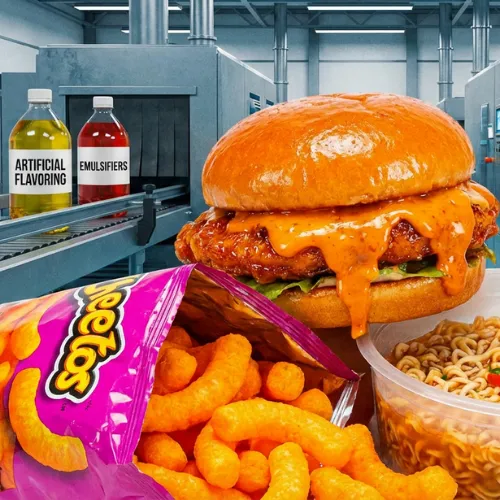
The Science Behind Ultra-Processed Food — How It Was Engineered Against You
When I started learning about how ultra-processed food was actually designed, the thing that hit me hardest was not the ingredients list. It was understanding that an entire scientific discipline exists whose sole purpose is to study how to make you unable to stop eating. That realization reframed everything — not as poor dietary choices but as deliberate engineering working against me at the biological level.
The food industry does not use the word 'addictive' in its internal communications. It uses 'craveable,' 'snackable,' 'highly palatable,' and 'consumer-preferred.' These are euphemisms for the same phenomenon: products engineered to produce disproportionate reward signals and suppress the brain's natural stopping mechanisms. The neurochemical mechanism behind why sugar and ultra-processed food are so hard to stop eating is documented in detail — and it goes deeper than most people realize.. Food scientist Steven Witherly — who consulted for major food companies and whose work is cited extensively in industry research — identified the specific mechanisms that make ultra-processed foods behaviorally difficult to stop eating:
1. Vanishing caloric density — foods engineered to dissolve quickly in the mouth signal 'low calorie content' to the brain despite being calorie-dense. The brain does not register fullness from them at the rate it should
2. Dynamic contrast — combining different textures in a single product maintains sensory engagement and delays the onset of sensory-specific satiety — the brain's natural 'enough of this' signal
3. Flavor layering — complex flavor profiles that change during chewing keep the brain engaged in sensory processing rather than transitioning to post-ingestive satiety signals
4. The bliss point — the mathematically optimized sugar-fat-salt ratio that Howard Moskowitz identified as maximizing the dopamine reward response while minimizing aversion from any single component
These mechanisms operate below conscious awareness. They are not perceived as manipulation. They are perceived as the product tasting good. The food technologist's job is to reverse-engineer the brain's stopping mechanisms — and the best ones are the ones you never notice doing it.
How Ultra-Processed Food Works on Your Body — Step by Step'
How Ultra-Processed Food Works on Your Body — Step by Step
Engineered palatability activates reward circuits
The bliss point formulation — optimized sugar, fat, and salt ratio — triggers a disproportionate dopamine release. Vanishing caloric density delays satiety signals. The brain registers intense reward with no corresponding fullness.
Refined starch and sugar drive a rapid insulin surge
Refined carbohydrates in UPFs digest almost instantly, producing a sharp glucose spike. The pancreas releases a large insulin response. Fat storage mode activates. Fat burning shuts off.
The gut lining is disrupted
Emulsifiers like carboxymethylcellulose and polysorbate-80 degrade the protective mucus layer of the intestine. Bacteria penetrate closer to the gut wall. Tight junctions between intestinal cells loosen — the gut barrier weakens.
Systemic inflammation begins
Lipopolysaccharides (LPS) from gut bacteria cross into circulation. The immune system mounts a response. TNF-alpha and IL-6 levels rise. Chronic low-grade inflammation develops — the same inflammatory state that underlies every major metabolic disease.
Insulin resistance develops
Inflammatory cytokines directly impair insulin receptor signaling in muscle and liver cells. Combined with chronic hyperinsulinemia from repeated glucose spikes, cells progressively stop responding to insulin. Fat storage increases. Fat burning becomes nearly impossible.
The brain stops receiving satiety signals
Leptin resistance develops — the brain no longer registers fullness from fat stores. Ghrelin fails to suppress after UPF meals. The body remains in a state of perceived hunger despite adequate or excess caloric intake. The cycle drives continued consumption.
Metabolic syndrome accumulates
Visceral fat increases. Triglycerides rise. Blood pressure elevates. Fasting glucose climbs. The five criteria of metabolic syndrome develop simultaneously — all driven by the same upstream cascade that began with a product engineered to be impossible to stop eating.
Emulsifiers: The Ingredient Quietly Destroying Your Gut
Among the additives in ultra-processed foods, emulsifiers deserve specific attention because their metabolic damage operates through a mechanism most consumers have never heard of. Emulsifiers are compounds that prevent oil and water from separating — they give processed foods their smooth, stable texture. Common emulsifiers include carboxymethylcellulose (CMC), polysorbate-80 (P80), lecithin, and carrageenan. They are present in thousands of products and generally recognized as safe by regulatory bodies.
Research at Georgia State University found that two common emulsifiers — carboxymethylcellulose and polysorbate-80 — disrupted the gut microbiome at concentrations comparable to those found in human diets. The emulsifiers degraded the protective mucus layer of the gut, allowed bacteria to penetrate closer to the intestinal wall, triggered low-grade intestinal inflammation, and promoted metabolic syndrome markers including obesity, elevated blood glucose, and insulin resistance — even in the absence of any dietary fat change. (Chassaing B et al. — Nature, 2015)
The California Lawsuit Connection:
A landmark lawsuit filed on behalf of the People of California against major food companies specifically names the commercial targeting of children as a deliberate strategy — citing decades of internal research showing that taste preferences established in childhood persist into adulthood
Companies named — Kraft Heinz, Mondelez, Coca-Cola, PepsiCo, General Mills, Kellogg, Nestlé, and ConAgra — allegedly understood that engineering hyperpalatable products for children was the most cost-effective long-term market strategy
The playbook, court filings allege, came directly from the tobacco industry — applied to food after tobacco companies acquired major food brands in the 1980s
What Ultra-Processed Food Does to Your Body
Here is how I want you to think about this. At any given moment, your entire bloodstream contains about one teaspoon of glucose — that is the body's set point, the level your pancreas works constantly to maintain. Think of the pancreas as a thermostat, sitting between your stomach and liver, monitoring blood glucose around the clock. When glucose rises — because you ate something — the thermostat kicks in, releasing insulin from its beta cells to bring blood sugar back down to that one teaspoon. When glucose falls, it releases glucagon to bring it back up. Everything in your metabolic health flows from how often and how sharply you force that thermostat to react.
Ultra-processed foods are designed to spike the thermostat as hard as possible, as fast as possible. Refined starch and high-fructose corn syrup stripped of fiber and food matrix digest almost instantaneously — glucose floods the bloodstream, the pancreas slams insulin, and fat storage mode activates while fat burning shuts off completely. Do this once and you recover. Do it three, five, eight times a day for years and the thermostat stops working as well as it should. Cells that were once responsive to insulin's signal start tuning it out. The pancreas compensates by producing more insulin. Fasting insulin climbs. HOMA-IR rises. And through all of it, fasting glucose looks normal on a standard blood test — hiding the dysfunction for years before it becomes visible.
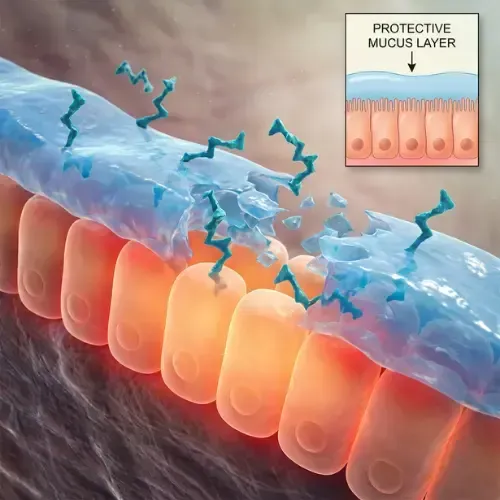
The emulsifiers in those same products are hitting the gut simultaneously. As the Chassaing research shows, they degrade the mucus layer protecting the intestinal wall, loosening the tight junctions that keep gut bacteria where they belong. Bacterial fragments — lipopolysaccharides — enter the portal circulation and reach the liver. The liver mounts an inflammatory response. That inflammatory signal impairs insulin receptor signaling in muscle and liver cells, compounding the insulin resistance already being built by the glucose spikes. Two separate pathways, one product, the same downstream outcome.
Then hunger hormones enter the picture. Ultra-processed foods impair both leptin and ghrelin signaling. Leptin — which normally signals the brain that fat stores are adequate and hunger can subside — becomes progressively less effective as UPF consumption drives chronic inflammation. The brain stops receiving the satiety signal even when the body has more than enough stored energy. Ghrelin, which should suppress after a meal, fails to do so after ultra-processed food consumption in the way it does after whole food consumption. The result is a person who has eaten enough calories but does not feel full — and whose biological drive to eat more is being generated by the food itself, not by any actual energy deficit.
500 Extra Calories Per Day
consumed spontaneously by participants on ultra-processed diets vs whole food diets — even when macronutrients, calories offered, and palatability ratings were matched
Hall KD et al. — Cell Metabolism, 2019 — the first randomized controlled trial directly comparing UPF vs whole food diets
The Reality of Ultra-Processed Food in America
More than 60% of the calories consumed by the average American adult come from ultra-processed foods. For children and adolescents, that figure is closer to 67%. These are not edge cases or occasional indulgences — ultra-processed foods are the foundation of the American diet, by design and by distribution. They are the cheapest calories available. They are the most heavily marketed. They are engineered to be the most compelling option in any food environment. And they are available at every gas station, checkout lane, vending machine, and dollar menu in the country.
I spent years eating this way without understanding what was actually happening. Not because I lacked information about nutrition in general, but because the specific knowledge — that these products were designed to override my biology, that the hunger I felt two hours after a processed meal was not a personal failure but a predictable chemical response to engineered food — was not part of the public conversation. What was part of the conversation was that I needed more willpower. That I needed to eat less and move more. That my weight was a character issue, not a product of a food environment that had been deliberately shaped to produce exactly this outcome.
The tobacco industry parallel is not rhetorical. When Philip Morris acquired General Foods in 1985 and R.J. Reynolds acquired Nabisco the same year, the methodologies that had been developed to maximize cigarette addiction — understanding and engineering neurochemical reward, identifying the most vulnerable consumers, building products around compulsion rather than satisfaction — transferred directly into food product development. The same scientists. The same consumer research frameworks. The same objective: a product that generates its own demand.
Understanding this does not make changing your diet easy, especially when you understand that the food pyramid's fingerprint is on most of our dietary advice. It makes it honest. The difficulty of the first two weeks of removing ultra-processed food from your diet — the cravings, the hunger, the irritability — is not evidence of weakness. It is neurochemical recalibration: dopamine receptor recovery, gut microbiome shifting, hunger hormone normalization. The food was designed to create exactly that withdrawal. Knowing it was designed that way changes how you navigate it.

How to Identify Ultra-Processed Food — The Ingredient Test
The most practical field test for ultra-processed food is the ingredient list, not the nutrition label. Nutrition labels tell you about macronutrients and calories — they do not tell you whether the food was industrially manufactured from food-derived substances for the purpose of maximizing palatability and shelf life. The ingredient list does.
When I started reading ingredient lists seriously, the first thing I noticed was how many products I had assumed were food contained things I had never seen in a kitchen. Here is what to look for:
1. Ingredients you would not find in a home kitchen — hydrolyzed protein, modified corn starch, sodium stearoyl lactylate, TBHQ, polydextrose, autolyzed yeast extract, xanthan gum — these are manufacturing inputs, not food
2. More than five ingredients — a rough but reliable signal. Bread made from flour, water, salt, and yeast is processed food. Bread with 30 ingredients is ultra-processed food. The number alone is informative
3. Multiple forms of the same ingredient — sugar appearing as high-fructose corn syrup, corn syrup solids, and dextrose in the same product is a formulation strategy — spreading sugar across multiple ingredient names keeps it from appearing at the top of the list
4. "Natural flavors" as a catchall — this is a regulatory term covering thousands of proprietary flavor chemicals. It appears on ultra-processed products as often as it appears on genuinely natural ones — it is not a meaningful quality signal
5. Emulsifier names — carboxymethylcellulose, polysorbate-80, carrageenan, lecithin — if these appear in the ingredient list, you are looking at a product whose texture was manufactured rather than inherent
6. Ingredient hierarchy — ingredients are listed in order of weight. If any form of sugar, refined oil, or modified starch appears in the first three ingredients, that is the product's primary building block
7. Marketing language above the ingredient list — 'made with whole grains,' 'contains real fruit,' 'no artificial colors,' 'natural' — none of these claims are regulated in ways that prevent their use on ultra-processed products. The ingredient list is the only honest part of the package
The substitution is not complicated once you understand the test. Whole foods — meat, fish, eggs, vegetables, fruit, nuts — have ingredient lists that are one item long. Their ingredient list is their name. Everything in the MAP30 framework is built around this distinction: foods the body recognizes as food versus products engineered to be consumed past the point of satiation.
This article is part of our Food, Sugar & Industry series. Food, Sugar & Industry
Latest Articles

Why Is Sugar So Addictive
Sugar addiction is not a character flaw or a lack of willpower. It is a neurochemical process — one the food industry spent decades studying.
What Are Hormones
Most people think about weight gain as a math problem — calories in versus calories out. The biology is more complex than that.

Fasting and Insulin Resistance
Your A1C came back normal. Your fasting glucose looks fine. Your doctor said everything is okay. But you’re still gaining weight..

John Shaw
MAP30 Challenge
John Shaw is a Certified Nutrition Educator and the founder of the MAP30 Challenge. What began as a personal health journey at 294 pounds, and pre-diabetic, evolved into a structured 30-day metabolic reset program grounded in nutritional science. John's mission is simple: give people the biological education that the diet industry never did.

FAQ's
1. What is ultra-processed food?
Ultra-processed foods are industrial formulations made primarily from substances extracted or synthesized from food — hydrolyzed proteins, modified starches, refined oils, artificial flavors, emulsifiers, and colorants. They contain little or no intact food and are designed to maximize palatability, shelf life, and compulsive consumption rather than nutritional value. The NOVA classification system identifies them as Group 4 foods — distinct from processed foods (Group 3) by their manufacturing purpose, not just their ingredients.
2. What does ultra-processed food vs real food actually mean?
Real food — unprocessed or minimally processed whole foods — has an ingredient list that is essentially its name: beef, eggs, broccoli, almonds. Ultra-processed food is an industrial formulation made from substances extracted from food, with additives included to extend shelf life, stabilize texture, and engineer palatability. The metabolic difference is not just calories — ultra-processed foods produce disproportionate insulin spikes, damage the gut barrier through emulsifiers, impair hunger hormone signaling, and drive chronic inflammation through pathways that whole foods do not activate.
3. Why is ultra-processed food bad for you?
Ultra-processed foods drive metabolic harm through multiple simultaneous pathways: disproportionate insulin spikes that produce insulin resistance over time; gut microbiome destruction and barrier damage from emulsifiers; hunger hormone dysregulation that impairs satiety even when caloric needs are met; and chronic low-grade inflammation from gut-derived bacterial fragments entering circulation. NIH research found participants spontaneously consumed 500 more calories per day on ultra-processed diets even when macronutrients were matched — demonstrating that the harm goes beyond caloric content.
4. What is the science behind ultra-processed food?
The science is hyperpalatability engineering — the systematic application of food science to maximize compulsive consumption. Key mechanisms include the bliss point (the optimized sugar-fat-salt ratio that maximizes dopamine reward), vanishing caloric density (foods that dissolve to delay fullness signaling), dynamic contrast (texture combinations that prevent sensory-specific satiety), and flavor layering that maintains sensory engagement past normal eating duration. These mechanisms were identified and applied deliberately by food scientists working with the explicit goal of making products that override the brain's stopping signals.
5. What are emulsifiers in food and why are they harmful?
Emulsifiers prevent oil and water from separating in processed products — they give foods their smooth, stable texture. Research published in Nature found that common emulsifiers carboxymethylcellulose and polysorbate-80 degraded the gut's protective mucus layer, disrupted the microbiome, triggered intestinal inflammation, and drove metabolic syndrome markers at concentrations comparable to normal dietary consumption. The damage operates through the gut-metabolic axis — independently of calories or sugar — making emulsifiers a mechanism of metabolic harm beyond what ingredient labels communicate.
6. How do you identify ultra-processed food?
Check the ingredient list, not the nutrition label. Ultra-processed food contains ingredients you would not find in a home kitchen — modified starches, hydrolyzed proteins, emulsifiers, artificial flavors, TBHQ. More than five ingredients is a reliable signal. Multiple forms of sugar (high-fructose corn syrup, corn syrup solids, dextrose) in one product is a formulation strategy. Marketing language — 'made with whole grains,' 'natural flavors,' 'no artificial colors' — has no regulatory definition preventing its use on ultra-processed products. The ingredient list is the only honest part of the package.
Sources
Hall KD et al. — 'Ultra-Processed Diets Cause Excess Calorie Intake and Weight Gain' (Cell Metabolism, 2019) — https://pubmed.ncbi.nlm.nih.gov/31105044/
Chassaing B et al. — 'Dietary emulsifiers impact the mouse gut microbiota promoting colitis and metabolic syndrome' (Nature, 2015) — https://pubmed.ncbi.nlm.nih.gov/25731162/
Monteiro CA et al. — 'Ultra-processed foods: what they are and how to identify them' (Public Health Nutrition, 2019) — https://pubmed.ncbi.nlm.nih.gov/30744710/
Rico-Campà A et al. — 'Association between consumption of ultra-processed foods and all cause mortality' (BMJ, 2019) — https://pubmed.ncbi.nlm.nih.gov/31142457/
Moss M — 'Salt Sugar Fat: How the Food Giants Hooked Us' (Random House, 2013) — https://www.penguinrandomhouse.com/books/209536/salt-sugar-fat-by-michael-moss/
Srour B et al. — 'Ultra-processed food intake and risk of cardiovascular disease' (BMJ, 2019) — https://pubmed.ncbi.nlm.nih.gov/31092531/

Let Me See The Ai Audit Report
I had the MAP30 course material audited and graded by 4 dirrerent Ai models. I was shocked by the grade. See what they had to say about the MAP30 course.

Jaabsha Marketing LLC | All rights reserved 2024 Terms Of Service