Edition: Food Sugar & Industry
26 February, 2026
In The News
Vol 1, Edition 3
San Francisco Takes Aim: Landmark Lawsuit Against Ultra Processed Food Giants
A first-of-its-kind lawsuit filed on behalf of the People of California accuses the country's largest food companies of knowingly engineering addiction, deceiving consumers, and targeting children — using the exact same playbook as Big Tobacco. Here's what the court filings actually reveal.
Edition: Food Sugar & Industry
26 February, 2026
In The News
Vol 1, Edition 3
San Francisco Takes Aim: Landmark Lawsuit Against Ultra Processed Food Giants
A first-of-its-kind lawsuit filed on behalf of the People of California accuses the country's largest food companies of knowingly engineering addiction, deceiving consumers, and targeting children — using the exact same playbook as Big Tobacco. Here's what the court filings actually reveal.

Published By: MAP30 Challenge
Authored By: John Shaw
70%
Of U.S. grocery products are ultra-processed food
2/3
Of children's daily calories come fro Ultra Processed Foods
$100B+
Annual U.S. cost attributed to UPFs (1999)
300K
Americans dying per year linked to UPF consumption
The Lawsuit That Could Change Everything
On December 2, 2025, San Francisco City Attorney David Chiu filed a landmark lawsuit on behalf of the People of the State of California in San Francisco Superior Court. The defendants? Some of the biggest names in American food and beverage: Kraft Heinz, Mondelez, Coca-Cola, PepsiCo, General Mills, Nestlé USA, Kellogg, Mars, Post Holdings, and ConAgra Brands.
This is not a case about food being unhealthy. According to the complaint, this is a case about companies that engineered products to be addictive, knew those products were making people sick, hid the science, and kept pushing more of the same — particularly at children.
The charges are brought under California's Unfair Competition Law and public nuisance statute. The state is seeking injunctions on deceptive marketing, corrective public education campaigns, limits on child-directed advertising, and billions in civil penalties and restitution to offset healthcare costs.
I
"These companies engineered a public health crisis, they profited handsomely, and now they need to take responsibility for the harm they have caused." — San Francisco City Attorney David Chiu
What Exactly Are Ultra-Processed Foods?
The lawsuit relies on the NOVA Classification System, the internationally recognized framework developed by epidemiologist Carlos Monteiro, to define ultra-processed foods (UPFs). According to NOVA, UPFs are not simply processed or pre-packaged foods — they are a fundamentally different category.
UPFs are assembled from cheap industrial ingredients — high-fructose corn syrup, maltodextrin, hydrogenated oils, soy protein isolate, artificial sweeteners, emulsifiers, color additives — using industrial techniques like extrusion, molding, hydrogenation, and pre-frying that most consumers have never heard of.
High-fructose corn syrup alone triggers a liver response that sets off insulin resistance, visceral fat accumulation, and inflammation independent of total calorie intake.

The complaint puts it plainly: ultra-processed foods are combinations of chemicals designed to stimulate cravings and encourage overconsumption.
UPF Health Risks Documented in the Filing
Type 2 diabetes
Fatty liver disease
Cardiovascular disease (the leading cause of death in San Francisco)
Colorectal cancer — doubled in young adults over the period of UPF's rise
Inflammatory bowel diseases, including Crohn's disease
Depression
Obesity rates have exploded. The number of people with diabetes has quadrupled. And the complaint draws a direct line from these trends to the deliberate flood of ultra-processed products into the American food supply.
The 1999 Meeting: They Knew. They Did Nothing.
This is perhaps the most explosive section of the entire lawsuit — and it reads like a scene from a corporate thriller.
On April 8, 1999, the CEOs of America's largest food companies gathered in Minneapolis. James Behnke, CTO of Pillsbury, and Michael Mudd, Vice President of Kraft (then a Philip Morris subsidiary), called the meeting with a specific purpose: to warn the industry that it had gone too far.
I
"There are no easy answers. But this much is clear: For those of us who've looked hard at this issue — we feel sure that the one thing we shouldn't do is nothing." — Michael Mudd, VP of Kraft, April 8, 1999
Mudd presented internal data showing that the ultra-processed food industry had caused childhood obesity rates to double, that UPF-related health conditions were costing the U.S. upwards of $100 billion a year, and that the toll was inflicting a public health crisis rivaling that of tobacco — killing an estimated 300,000 Americans annually.
The presentation was not well received. The other CEOs in the room denigrated the concerns and dismissed the data. According to the complaint, they were entirely unmoved. If anything, they were emboldened. And then they kept going.
This is not a theory. This is in the court filing — drawn from internal documents and firsthand accounts of that meeting. These companies had actual knowledge of the harm they were causing, and they chose profit over public health.
Big Tobacco Becomes Big Food
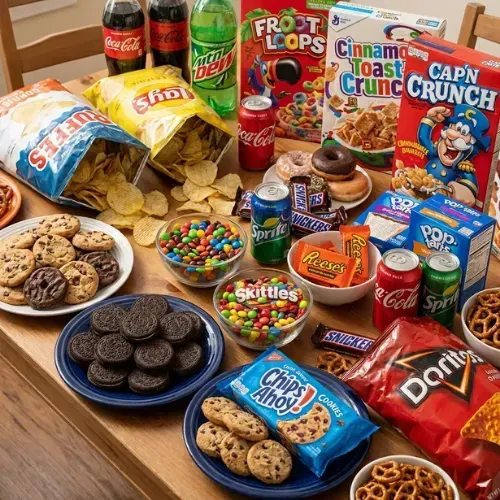
One of the most chilling revelations in the lawsuit is the direct, documented transfer of addiction science from the tobacco industry to the food industry.
Starting in the 1960s and accelerating through the 1980s, tobacco giants Philip Morris and R.J. Reynolds began acquiring major food brands at massive scale. Philip Morris acquired General Foods and Kraft, making the combined entity the world's largest food company and the world's largest consumer products company.
A Philip Morris executive reportedly explained: 'You can now have a complete meal of Philip Morris foods and beverages, followed, of course, by one of our cigarettes.'
R.J. Reynolds, meanwhile, purchased Hawaiian Punch, Nabisco, and Del Monte, among others. These weren't passive investments. The tobacco companies integrated their food acquisitions directly into their corporate structures — which meant a systematic transfer of people, knowledge, and technology from tobacco to food.
What kind of knowledge? Expertise in designing addictive products. In managing damaging science. In marketing to vulnerable populations. In manufacturing cravings.
UPF Health Risks Documented in the Filing
| Big Tobacco Tactic | How Big Food Applied It |
|---|---|
| Nicotine engineering for addiction | Designing UPFs to hack the brain's reward system — described in filings as deploying 'all of the pleasure drugs that are not regulated' |
| Youth marketing with mascots | Tired of waiting? Here is the complete table with the original image content. |
| Denial, doubt, delay on health science | Internal warnings buried; public messaging continued to frame UPFs as convenient, modern, and healthy |
| Targeting underserved communities | 70% more ads directed at Black and Latino children vs. white children |
| Lobbying against regulation | Sustained industry pressure against labeling reforms, advertising limits, and dietary guidelines |
Big Tobacco Tactic
How Big Food Applied It
Nicotine engineering for addiction
Designing UPFs to hack the brain's reward system — described in filings as deploying 'all of the pleasure drugs that are not regulated'
Youth marketing with mascots
Tony the Tiger, Fred Flintstone, cartoon characters across cereal, candy, and snack brands
Denial, doubt, delay on health science
Internal warnings buried; public messaging continued to frame UPFs as convenient, modern, and healthy
Targeting underserved communities
70% more ads directed at Black and Latino children vs. white children
Lobbying against regulation
Sustained industry pressure against labeling reforms, advertising limits, and dietary guidelines
Targeting Children: A Documented Strategy

The lawsuit's section on children is particularly damning — and detailed. This wasn't accidental marketing overlap. It was a deliberate, systematic strategy to hook children early and create lifelong customers.
In the 1990s, Philip Morris-owned Kraft maintained what was internally called a 'Kids Task Force.' The head of the task force reportedly boasted that their promotions would reach about 95% of kids in the 6 to 12 age group in the U.S. That's not a marketing campaign. That's saturation.
The companies ran integrated campaigns with some of the biggest names in children's media and toys — Disney, Nickelodeon,
Mattel, Nintendo, and Marvel — surrounding kids with consistent product messaging across every environment where they lived, learned, and played. The complaint draws an explicit parallel to tobacco's strategy of making its brand omnipresent in everyday life.
I
Cartoon mascots, cross-promotions with Disney and Nintendo, ads during kids' shows, school-linked promotions — all of it designed to hook children early, before they had the knowledge or autonomy to push back.
The complaint also highlights a particularly troubling element: harmful dyes. The companies allegedly used artificial color additives specifically to make ultra-processed foods more visually appealing to children — despite evidence linking certain dyes to behavioral issues in kids.
The Racial Disparity in Targeting
The lawsuit doesn't stop at children broadly. It specifically documents how Black and Latino children were disproportionately targeted — and how that targeting maps directly onto disproportionate health outcomes.
Black and Latino children are exposed to approximately 70% more ultra-processed food advertisements than white children
The prevalence of diabetes among Black Americans quadrupled over the past 30 years
Black Americans are 70% more likely to develop diabetes than white Americans
In San Francisco specifically, hospitalization rates for diabetes are 3 to 6 times higher in Black communities compared to all other racial and ethnic groups
Death rates from diabetes in San Francisco's Black communities are 2 to 3 times higher than those of other groups
The complaint connects these numbers directly to targeted marketing strategies — not poverty alone, not genetics, but deliberate corporate choices about where to concentrate advertising dollars and product placement.
Hacking the Human Brain: The Addiction Science
The legal framing of addiction is central to this case. The complaint argues — based on a growing body of scientific research — that ultra-processed foods aren't merely tempting. They are physiologically addictive in ways that parallel drugs and tobacco.
The filing describes UPFs as psychoactive substances that activate the brain's reward circuitry in the same way as controlled substances. They are reinforcing — meaning the more you consume them, the more you want them. And they cause compulsive use patterns even when the person consuming them wants to stop.
According to the lawsuit, this wasn't a side effect of manufacturing. It was a design feature. Defendants are accused of actively deploying addiction science — originally developed for cigarettes — to engineer more addictive food products with the explicit goal of driving repeat purchases. The filing describes it as using 'all of the pleasure drugs that are not regulated.'
The bliss point research that has been widely documented in the food industry — engineering the precise balance of salt, sugar, and fat to maximize palatability and minimize satiety — fits squarely within this framework.
The deliberate suppression of satiety signals is the opposite of how real food works — whole food sources like grass-fed beef naturally support the metabolic signals your brain needs to feel full and stop eating.
The Illusion Of Choice
Walk into any grocery store and you'll see dozens of different brands, hundreds of products, and an apparent abundance of options. The lawsuit calls this out as exactly what it is: an illusion.
Approximately 70% of all U.S. grocery store products are ultra-processed. And the vast majority of those products are made by the same small cluster of conglomerates named in this lawsuit. Consumers are not choosing between genuinely different foods. According to the complaint, they are choosing between different configurations of chemicals produced by a handful of mega-corporations.
The Brands Behind the Lawsuit — Just Some of What's Named
| Company | Some Brands Involved |
|---|---|
| Kraft Heinz | Oscar Mayer, Lunchables, Capri Sun, Kool-Aid, Velveeta, Jell-O |
| Mondelez | Oreo, Ritz, Chips Ahoy!, Sour Patch Kids, Cadbury, Swedish Fish |
| Coca-Cola | Coca-Cola, Sprite, Fanta, Minute Maid, Powerade, Vitamin Water |
| PepsiCo | Pepsi, Doritos, Lays, Cheetos, Gatorade, Cap'n Crunch, Mountain Dew |
| General Mills | Lucky Charms, Cocoa Puffs, Cinnamon Toast Crunch, Trix, Betty Crocker |
| Kellogg / Kellanova | Frosted Flakes, Froot Loops, Pop-Tarts, Pringles, Eggo, Rice Krispies Treats |
| Nestlé USA | Hot Pockets, DiGiorno, Stouffer's, Lean Cuisine, Nesquik, Drumstick |
| ConAgra | Chef Boyardee, Slim Jim, Kid Cuisine, Orville Redenbacher's, Swiss Miss |
Company
Some Brands Involved
Kraft Heinz
Oscar Mayer, Lunchables, Capri Sun, Kool-Aid, Velveeta, Jell-O
Mondelez
Oreo, Ritz, Chips Ahoy!, Sour Patch Kids, Cadbury, Swedish Fis
Coca-Col
Coca-Cola, Sprite, Fanta, Minute Maid, Powerade, Vitamin Water
PepsiCo
Pepsi, Doritos, Lays, Cheetos, Gatorade, Cap'n Crunch, Mountain Dew
General Mills
Lucky Charms, Cocoa Puffs, Cinnamon Toast Crunch, Trix, Betty Crocker
Kellogg / Kellanova
Frosted Flakes, Froot Loops, Pop-Tarts, Pringles, Eggo, Rice Krispies Treats
Nestlé USA
Hot Pockets, DiGiorno, Stouffer's, Lean Cuisine, Nesquik, Drumstick
ConAgra
Chef Boyardee, Slim Jim, Kid Cuisine, Orville Redenbacher's, Swiss Miss
The Deny, Denounce, Delay Strategy
The complaint dedicates an entire section — titled 'Deny, Denounce, Delay' — to the industry's strategy of burying the science and manufacturing doubt. Sound familiar? It's the same chapter the tobacco industry wrote.
Internal meetings were held where health concerns were raised and dismissed. Public-facing messaging continued to frame UPFs as part of a balanced, convenient lifestyle. When scientific evidence linking UPFs to disease began mounting, the industry didn't act — it lobbied, it funded counter-research, and it kept marketing.
The suit argues that this wasn't negligence. It was a calculated, sustained effort to protect profit by depriving consumers of accurate information — while knowing that the products were causing mass harm.
I
"Quite simply, change will have to be forced — by public pressure, media attention, and litigation." — Michael Mudd, after resigning from Kraft
The Public Health Price Tag
The lawsuit isn't just about accountability in the abstract. It's about money — specifically, the billions in taxpayer dollars being spent to treat diseases tied directly to ultra-processed food consumption.
$124B
Medi-Cal expenditures in 2024
$3.95B
of that spending attributable to San Francisco
$85M+
in SF hospital charges from diabetes in 2016 alone
$7T
projected national healthcare spending by 2031
National health expenditures have ballooned from 5% of GDP in 1960 to nearly 20% today. The suit argues that this trajectory is not inevitable — it is the direct result of corporate conduct. And the state is demanding that Big Food help foot the bill.
What California Is Asking For
The lawsuit seeks several distinct forms of relief, making clear that this is about systemic change — not just a financial settlement.
A statewide court order prohibiting deceptive marketing practices
Mandatory corrective campaigns to educate the public on the true health risks of ultra-processed foods
Restrictions on child-directed advertising for ultra-processed products
Restitution to help offset the healthcare costs borne by California taxpayers
Civil penalties under the California Unfair Competition Law
San Francisco Supervisor Shamann Walton, a vocal supporter of the case, also introduced a parallel resolution urging city departments to audit their own use of ultra-processed foods — a signal that this moment is catalyzing policy action well beyond the courtroom.
Why This Case Matters — Even If You Don't Live in California
This is being called a first-of-its-kind lawsuit for a reason. If California succeeds, it will establish a legal framework that other cities and states can use to file their own suits. The tobacco litigation of the 1990s ended in a $246 billion multistate settlement. Legal analysts are already drawing direct comparisons.
The firms representing California — Morgan & Morgan, DiCello Levitt, and Andrus Anderson — are not small players. They specialize in mass tort and public entity litigation. They are in this for the long game.
But beyond the legal precedent, this case is raising a question that every parent, every shopper, every American deserves an honest answer to: Did the companies that make the food lining our grocery store shelves know it was making us sick — and decide that didn't matter?
Based on the court filings, the answer appears to be yes.
I
The internal documents they're trying to hide? Based on what's already in the complaint, they're devastating.
What You Can Do Right Now
You don't have to wait for a court ruling to start making more informed decisions. Here's where to begin:
Learn the NOVA Classification System — it's the clearest framework for identifying ultra-processed foods in your diet
Read ingredient lists rather than nutrition panels; if it contains additives you can't replicate at home, it's likely ultra-processed
Follow the case at SF.gov — the full complaint is publicly available and worth reading
Talk to your kids about food marketing — they're being targeted; they deserve to know it
Support local food policy efforts that prioritize whole and minimally processed foods in schools and public institutions
This lawsuit won't change overnight what's on the shelves. But it is forcing a reckoning that the food industry has delayed for over 25 years. The question now is whether the courts — and the public — will hold them accountable.
This article is part of our Food, Sugar & Industry series. Food, Sugar & Industry
Latest Articles

Grass-Fed Beef B12
Why the “second-hand B12” argument falls apart when you look at deficiency rates, evolutionary biology, and what actually happens in a cow’s rumen...

Type 2 Diabetes
Your A1C is below 6.5%. You're off medication. You feel better than you have in years. So why does your chart still say 'diabetes'? The answer...

Calorie Deficit
The calorie deficit model has been the foundation of weight loss advice for over a century. But millions of people follow it precisely — and still...

John Shaw
MAP30 Challenge
John Shaw is a Certified Nutrition Educator and the founder of the MAP30 Challenge. What began as a personal health journey at 294 pounds, and pre-diabetic, evolved into a structured 30-day metabolic reset program grounded in nutritional science. John's mission is simple: give people the biological education that the diet industry never did.
Disclaimer: This article is for educational purposes only and does not constitute medical advice. Individual results vary. Always consult your healthcare provider before making dietary changes, especially if you have a medical condition or take medications.
FAQ's
1. Why am I not losing weight if I'm eating in a calorie deficit?
The most likely explanation is metabolic adaptation — your body has responded to reduced calorie intake by lowering the amount of energy it burns. BMR (your baseline calorie burn) can drop by 15 to 25% during sustained calorie restriction, and NEAT (non-exercise movement) also decreases. This means the deficit you calculated on paper may no longer exist inside your body. Hormonal factors, particularly elevated insulin in people with insulin resistance, can also lock the body into storage mode even when calories are low. The short answer: eating less is not always enough, and for many people, the hormonal environment matters more than the calorie math.
2. How accurate are calorie counts on food labels?
Less accurate than most people realize. Food labels in the U.S. still use the Atwater system — a formula developed in the 1890s that assigns fixed calorie values to macronutrients based on how much heat food produces when burned outside the body. Modern research shows several gaps: fiber-rich foods may deliver 20–30% fewer usable calories than the label states; processing significantly increases calorie availability (a raw almond vs. processed almond butter are not metabolically equivalent); and individual gut microbiome differences mean two people can absorb different amounts from the exact same meal. The 3,500 calorie = 1 pound rule, still used in most weight loss calculators, was based on a single 1958 paper and has never been validated as a precise formula. The numbers on labels are useful estimates — not precise measurements of what your body will absorb.
3. What is metabolic adaptation and how do I fix it?
Metabolic adaptation is your body's survival response to calorie restriction. When calories drop, your body reduces how much energy it burns — lowering BMR, suppressing NEAT (unconscious daily movement), and altering hormones like leptin and ghrelin to increase hunger. The good news: research from the University of Alabama at Birmingham has shown that metabolic adaptation is not permanent. A short period of weight stabilization — even just two weeks of eating at maintenance calories — can significantly reduce or reverse it. From there, reintroducing a moderate deficit tends to produce better results than continued aggressive restriction. Prioritizing protein intake and resistance training are also well-supported strategies for limiting how much metabolic adaptation occurs during weight loss.
4. Does insulin affect weight loss? What is the connection between insulin and fat storage?
Insulin is the primary storage hormone in the human body. When insulin levels are elevated, fat burning is suppressed — the body is in 'store mode.' In people with insulin resistance (estimated to affect around 40% of U.S. adults according to Yale School of Medicine research), insulin levels stay chronically elevated even in a fasted state, because cells aren't responding normally and the pancreas compensates by producing more. This can make fat loss physiologically difficult regardless of calorie intake. The Carbohydrate-Insulin Model of obesity, published in PMC, argues that for insulin-resistant individuals, reducing refined carbohydrates — which are the primary driver of insulin secretion — may be more effective for fat loss than simply cutting total calories.
5. Should I count calories to lose weight, or is there a better approach?
Calorie awareness is useful — but calorie counting alone is an incomplete strategy for many people, particularly those dealing with metabolic adaptation, insulin resistance, or hormonal imbalances. A more effective framework focuses on the hormonal environment first: reducing refined carbohydrates to lower insulin, prioritizing protein to support muscle retention and satiety, and incorporating time-restricted eating to create sustained low-insulin windows that allow fat oxidation. Calories still matter in the background, but for people who have been stuck despite tracking precisely, addressing the hormonal drivers tends to produce results that calorie math alone cannot. Work with a healthcare provider if you suspect insulin resistance or have an underlying metabolic condition — these are medical issues, not discipline issues.
Sources
Calorie Restriction
Impact of Calorie Restriction on Energy Metabolism in Humans — PMC / NCBI
https://pmc.ncbi.nlm.nih.gov/articles/PMC9036397/
Metabolic Adaptation
Metabolic Adaptation Delays Time to Reach Weight Loss Goals — PMC / Obesity Journal
https://pmc.ncbi.nlm.nih.gov/articles/PMC8852805/
Metabolic Adaptation
Tissue Losses and Metabolic Adaptations Both Contribute to the Reduction in RMR — Nature / Int. Journal of Obesity
https://www.nature.com/articles/s41366-022-01090-7
Calorie Label Accuracy
Science Reveals Why Calorie Counts Are All Wrong — Scientific American
https://www.scientificamerican.com/article/science-reve…
Food Labels Accuracy
Are the Calorie Counts on Food Labels Accurate? — Discover Magazine
https://www.discovermagazine.com/are-the-calorie-counts…
Calorie Label Accuracy
Accuracy of the Atwater Factors with High-Fiber Diets — ScienceDirect
https://www.sciencedirect.com/science/article/pii/S0002…
Insulin & Fat Storage
The Carbohydrate-Insulin Model of Obesity: Beyond 'Calories In, Calories Out' — PMC

Let Me See The Ai Audit Report
I had the MAP30 course material audited and graded by 4 dirrerent Ai models. I was shocked by the grade. See what they had to say about the MAP30 course.

Jaabsha Marketing LLC | All rights reserved 2024 Terms Of Service