Edition: Fasting & Metabolic Reset
18 March, 2026
In The News
Vol 1, Edition 13
Intermittent Fasting: The Science of Going Without Food
Most people think fasting is about willpower. The biology tells a different story. When you stop eating, your body doesn't go into starvation mode — it goes into repair mode. Here's what actually happens, hour by hour, and why it matters for insulin resistance, fat burning, and metabolic reset.

Published By: MAP30 Challenge | Authored By: John Shaw
What Happens to Your Body During a 16-Hour Fast
Most people are told that fasting is dangerous — that skipping meals slows your metabolism, causes muscle loss, and puts your body into starvation mode. This is one of the most persistent and consequential myths in nutrition.
The biology of fasting is not a biology of deprivation. It is a biology of switching. When you stop eating, your body doesn't panic — it shifts. It moves from a fed state, running on incoming glucose, to a fasted state, running on stored fat and ketones. That shift is the mechanism behind nearly every metabolic benefit associated with fasting: improved insulin sensitivity, fat burning, cellular repair, and reduced inflammation.
Understanding how that shift works — and why it is particularly important for people with insulin resistance — changes how you think about not eating. Fasting is not something you survive. It's something your body was designed to do.
| Hour | What's Happening | Metabolic Significance |
|---|---|---|
| 0–2 hrs | Blood glucose rises. Insulin released to manage it. | Fed state. Fat burning is OFF. |
| 2–5 hrs | Glucose absorbed. Insulin begins to fall. | Transition zone. Liver glycogen being used. |
| 5–8 hrs | Insulin continues falling. Liver starts releasing stored glucose. | Body is running on glycogen reserves. |
| 8–12 hrs | Glycogen depletes. Fat cells begin releasing fatty acids. | Fat burning begins. Ketone production starts. |
| 12–16 hrs | Insulin at its lowest. Significant fat oxidation. Growth hormone rising. | Peak fat-burning window. Cellular repair (autophagy) activating. |
The Fed State vs. The Fasted State: A Fundamental Metabolic Divide
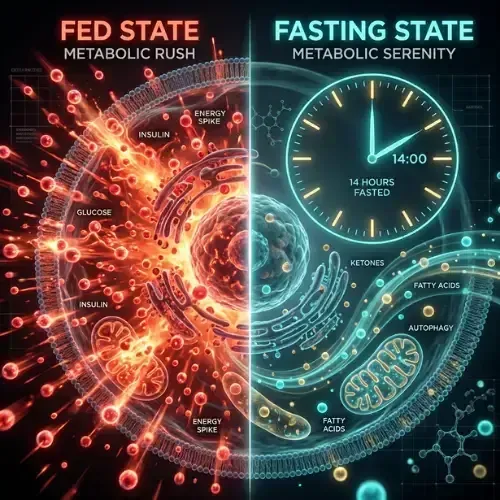
Your metabolism operates in one of two primary states at any given time: fed or fasted. These are not arbitrary categories — they represent fundamentally different hormonal environments that determine whether your body is building and storing, or breaking down and repairing.
In the fed state — the hours after eating — insulin is elevated. Insulin's job is to move glucose from the bloodstream into cells for energy, and to store the excess as glycogen in the liver and muscles, or as fat. This is normal, healthy function. The problem arises when this state becomes chronic — when eating frequency and carbohydrate load keep insulin perpetually elevated, never allowing the body to shift out of storage mode.
In the fasted state — the hours after insulin falls — something different happens. With no incoming glucose and insulin falling, the body turns to its stored reserves. The liver begins converting glycogen back into glucose. As glycogen depletes, fat cells begin releasing stored fatty acids. The liver converts these fatty acids into ketones — an alternative fuel that the brain, heart, and muscles can use efficiently. Fat burning is not just permitted in this state. It is the design.
"The fasted state is not starvation. It is the metabolic environment your body was designed to spend significant time in — and most people with insulin resistance never get there."
Why Insulin Is the On/Off Switch for Fat Burning
The relationship between insulin and fat burning is binary in a way that most people do not appreciate. You cannot burn stored fat and have elevated insulin at the same time. Insulin is the switch, and fat burning only happens when it is off.
This is the central reason why people with insulin resistance — who have chronically elevated insulin — struggle to lose fat through calorie restriction alone. Even in a calorie deficit, elevated insulin continues to suppress lipolysis: the release of stored fatty acids from fat cells. The fat is there. The body simply cannot access it.
Fasting lowers insulin directly and reliably. Every hour without food is an hour of falling insulin. By the 12–16 hour mark, insulin has dropped to levels low enough to fully unlock fat burning. This is the metabolic switch — the shift from glucose-dependent to fat-dependent metabolism — and for people with insulin resistance, getting here consistently is one of the most important metabolic changes possible.
🔬 CLINICAL STUDY — Sutton EF et al. (2018)
Cell Metabolism, 27(6), 1212–1221.
A randomized controlled trial of early time-restricted feeding (eTRF) — eating within a 6-hour window ending before 3pm — found significant improvements in insulin sensitivity, blood pressure, and oxidative stress in men with prediabetes, even without weight loss. Fasting insulin fell significantly in the eTRF group compared to controls eating across a 12-hour window.
What This Means: Fasting-induced insulin reduction produces measurable metabolic improvements independent of caloric restriction or weight loss. The fasting window itself is the active intervention.
The Metabolic Switch: When Your Body Changes Fuel Sources
The transition from burning glucose to burning fat is not instantaneous. It follows the glycogen depletion curve — the process by which the liver empties its stored glucose before the body commits to fat as its primary fuel. This typically occurs somewhere between 10 and 14 hours of fasting, depending on the individual's metabolic state and what was eaten before the fast.
For someone who is metabolically flexible — able to shift between fuel sources efficiently — this transition is smooth. Energy is stable. Hunger is manageable. Mental clarity is often reported to improve once ketones become available as fuel.
For someone with insulin resistance, the transition is harder. Cells have been running on glucose for so long that the enzymatic machinery for fat oxidation is downregulated. The first several fasting periods may feel difficult — hunger spikes, irritability, brain fog, fatigue. These are largely adaptation symptoms. The body is rebuilding the metabolic pathways it has not used in years.
Research from Dr. Mark Mattson at the National Institute on Aging describes this transition — from glucose to ketones as the primary brain fuel — as one of the most significant metabolic events the body can undergo. It triggers a cascade of beneficial adaptations: increased mitochondrial efficiency, reduced oxidative stress, improved insulin sensitivity, and activation of cellular repair pathways including autophagy.

Intermittent Fasting and Insulin Resistance: What the Research Shows
The evidence for intermittent fasting as a tool for improving insulin resistance has grown substantially over the past decade. The findings across multiple study designs are consistent.
🔬 CLINICAL STUDY — Gabel K et al. (2018)
Nutrition and Healthy Aging, 4(4), 345–353.
A 12-week study of 16:8 intermittent fasting in adults with obesity found significant reductions in body weight, fat mass, fasting insulin, and blood pressure compared to a control group eating without time restriction. Caloric intake was similar between groups — suggesting the metabolic benefit was driven by the fasting window rather than reduced eating.
What This Means: 16:8 fasting produces measurable improvements in insulin and fat mass beyond what is explained by calorie reduction alone. The timing of eating matters independently of how much is eaten.
A 2020 review in the New England Journal of Medicine, authored by Dr. Mark Mattson, synthesized data from multiple clinical trials and concluded that intermittent fasting consistently reduces fasting insulin, fasting glucose, and HbA1c in people with prediabetes and type 2 diabetes — with effect sizes comparable to those achieved by caloric restriction, but with substantially better adherence in many populations.
16:8 Intermittent Fasting vs. Calorie Restriction: Key Differences
| Factor | 16:8 Fasting | Calorie Restriction |
|---|---|---|
| Primary mechanism | Lowers insulin through fasting window | Reduces total caloric intake |
| Effect on insulin | Direct — sustained low insulin for 12–16 hrs | Indirect — only if carbohydrates are reduced |
| Fat burning activation | High — triggered by insulin nadir | Moderate — depends on insulin response |
| Autophagy activation | Yes — begins after ~12 hrs fasting | Minimal — requires prolonged restriction |
| Long-term adherence | Generally higher | Generally lower |
| Metabolic adaptation | Less pronounced | Significant — metabolism slows with restriction |
Autophagy: The Cellular Repair Process Fasting Activates
One of the most significant effects of extended fasting has nothing to do with fat or insulin. It is a cellular cleanup process called autophagy — from the Greek for 'self-eating' — in which cells identify and break down damaged components: dysfunctional mitochondria, misfolded proteins, cellular debris accumulated from normal metabolic activity.
Autophagy is activated when the cell detects nutrient scarcity — the fasted state. It is suppressed by insulin and mTOR, both of which are elevated in the fed state. This means autophagy and eating are essentially incompatible. The cellular repair system is switched on by the absence of food.
The 2016 Nobel Prize in Physiology or Medicine was awarded to Yoshinori Ohsumi for his work on the mechanisms of autophagy. His research, and subsequent clinical work, established autophagy as a fundamental biological process with implications for aging, cancer, neurodegenerative disease, and metabolic function.

In the context of insulin resistance specifically, impaired autophagy has been linked to the accumulation of dysfunctional mitochondria in insulin-sensitive tissues — contributing to the energy production deficits and insulin signaling failures that characterize metabolic dysfunction.
"The Nobel Prize was awarded for discovering that fasting activates cellular self-cleaning. Your body has a built-in maintenance system — it just needs you to stop eating long enough to turn it on."
The 16:8 Protocol: How to Start
The most researched and most practical intermittent fasting protocol for metabolic health is 16:8 — a 16-hour fasting window with an 8-hour eating window. For most people, this means skipping breakfast and eating between approximately 11am and 7pm, or noon and 8pm.
What matters is consistency of the fasting window, not the specific hours. The metabolic benefits accrue from regularly achieving the 12–16 hour mark where insulin reaches its nadir and fat burning activates. Missing this threshold — by eating a late-night snack or eating breakfast before the window is complete — resets the clock.
What to expect in the first two weeks
• Week 1: Morning hunger, mid-morning fatigue, possible irritability. These are adaptation symptoms as the body shifts from glucose dependence. They typically peak around days 3–4 and begin resolving by day 7.
• Week 2: Fasting window becomes easier. Hunger in the morning begins to decline. Energy stabilizes once the fat-burning pathway is more established.
• Weeks 3–4: Most people report that the fasting period feels natural. The eating window provides adequate satiety without requiring excessive caloric compensation.
What breaks a fast
Water, plain black coffee, and plain tea do not break a fast in the metabolically significant sense — they do not raise insulin. Any food, sweetened beverages, cream in coffee, or caloric supplements will raise insulin and reset the fasting clock to zero.
⚠️ Medical Disclaimer:
If you are on medication for type 2 diabetes — particularly insulin or sulfonylureas — fasting requires medical supervision. Blood sugar can drop significantly during fasting periods and medication doses may need adjustment. Always consult your healthcare provider before beginning any fasting protocol if you are on glucose-lowering medication.
Why Fasting Works Better for Some People Than Others
Not everyone responds to intermittent fasting identically, and the differences are largely explained by metabolic baseline and the degree of insulin resistance present at the start.
People who are already metabolically flexible — with relatively normal insulin sensitivity and lower fasting insulin — typically adapt quickly and experience the benefits of fasting within one to two weeks. The metabolic switch is functional; it just needs to be used more regularly.
People with significant insulin resistance adapt more slowly. Their cells have been dependent on glucose for years, and the enzymatic and hormonal machinery for fat oxidation is substantially downregulated. The adaptation period may be four to eight weeks before the fasting window feels manageable and metabolic markers begin to shift. This does not mean fasting is not working. It means the metabolic rehabilitation takes longer.
The key variable tracked in research as a marker of improvement is fasting insulin — not fasting glucose. Fasting glucose normalizes after fasting begins, often within days, because blood sugar regulation improves quickly. Fasting insulin takes longer to fall and is the more accurate reflection of whether insulin sensitivity is genuinely improving.
What This Means for the MAP30 Challenge
The MAP30 Challenge is built around the same metabolic principles that make intermittent fasting effective. The 30-day protocol creates the hormonal environment — consistently low insulin, regular access to fat as fuel, improved cellular energy production — that underpins every element of metabolic health.
Fasting is not a separate protocol layered on top of MAP30. It is built into the framework. The timing of eating within MAP30 is designed to consistently reach the fasting threshold where the metabolic switch activates. The dietary composition is designed to minimize the insulin load during eating windows so that the fasted state is entered efficiently.
If you have been eating well and still not seeing results — if the scale is not moving and your energy has not improved — the missing variable may be the fasting window. Not what you are eating, but when you are eating it.
This article is part of our Fasting & Metabolic Reset series. Fasting & Metabolic Reset
Latest Articles
How to Lower Cortisol
You’ve been told stress makes you eat more. That’s only part of the story. Cortisol directly instructs your body to store fat...

Ozempic and GLP-1
GLP-1 drugs work. That part is true. What the headlines skip is how they work, what happens when you stop...

Chronic Inflammation
Chronic inflammation is not the redness and swelling of an injury. It is a silent, systemic biological state that disrupts hormones...

John Shaw
MAP30 Challenge
John Shaw is a Certified Nutrition Educator and the founder of the MAP30 Challenge. What began as a personal health journey at 294 pounds, and pre-diabetic, evolved into a structured 30-day metabolic reset program grounded in nutritional science. John's mission is simple: give people the biological education that the diet industry never did.
Disclaimer: The information in this article is for educational purposes only and does not constitute medical advice. Fatigue and related symptoms can have many causes, some of which require medical evaluation and treatment. Nothing in this article should be interpreted as a recommendation to change, stop, or start any medication or treatment plan. Always consult a qualified healthcare provider before making significant changes to your diet or lifestyle..
FAQ's
1. What is intermittent fasting and how does it work?
Intermittent fasting is a pattern of eating that cycles between defined periods of eating and not eating. It works primarily by lowering insulin during the fasting window, which allows the body to shift from burning glucose to burning stored fat. The metabolic benefits — improved insulin sensitivity, fat oxidation, and cellular repair — are largely driven by the duration and consistency of the fasting period, not by caloric restriction alone.
2. How long does it take for intermittent fasting to work for insulin resistance?
Fasting glucose typically improves within the first one to two weeks as blood sugar regulation improves. Fasting insulin — the more meaningful marker of insulin sensitivity — takes longer: most clinical studies show significant improvements after 8 to 12 weeks of consistent practice. Adaptation symptoms (morning hunger, fatigue) usually resolve within one to two weeks.
3. What is the best intermittent fasting schedule for beginners?
16:8 — a 16-hour fasting window with an 8-hour eating window — is the most researched and most practical starting protocol. A common structure is eating between 11am and 7pm, which means skipping breakfast and not eating after dinner. This consistently reaches the 12–16 hour threshold where insulin reaches its lowest point and fat burning activates.
4. Does intermittent fasting slow your metabolism?
No — and this is one of the most persistent myths about fasting. Short-term fasting of 16–24 hours does not reduce resting metabolic rate. Research consistently shows that short-term fasting slightly increases metabolic rate through elevated norepinephrine and growth hormone. Metabolic slowdown is associated with prolonged caloric restriction — not with fasting windows of 16 to 24 hours.
5. What is autophagy and when does it start during fasting?
Autophagy is a cellular repair process in which cells identify and break down damaged components — dysfunctional mitochondria, misfolded proteins, cellular debris. It is activated by nutrient scarcity and suppressed by insulin. Meaningful autophagy activation typically begins after 12–16 hours of fasting. It is one of the primary mechanisms by which fasting reduces oxidative stress, slows aging markers, and improves mitochondrial function.
6. Is intermittent fasting safe for people with type 2 diabetes?
Research consistently shows that intermittent fasting improves blood sugar control in people with type 2 diabetes, with reductions in fasting glucose, fasting insulin, and HbA1c documented across multiple clinical trials. However, people on glucose-lowering medication — particularly insulin or sulfonylureas — must have their medication adjusted before fasting to prevent hypoglycemia. Medical supervision is required for this population.
Sources
Sutton EF et al. — 'Early Time-Restricted Feeding Improves Insulin Sensitivity, Blood Pressure, and Oxidative Stress Even without Weight Loss in Men with Prediabetes' (Cell Metabolism, 2018)
https://pubmed.ncbi.nlm.nih.gov/29754952/
Gabel K et al. — '16:8 time-restricted eating and metabolic risk in adults with obesity' (Nutrition and Healthy Aging, 2018)
https://pubmed.ncbi.nlm.nih.gov/29951594/
Mattson MP et al. — 'Intermittent metabolic switching, neuroplasticity and brain health' (Nature Reviews Neuroscience, 2018)
https://pubmed.ncbi.nlm.nih.gov/29201964/
Anton SD et al. — 'Flipping the Metabolic Switch: Understanding and Applying Health Benefits of Fasting' (Obesity, 2018)
https://pubmed.ncbi.nlm.nih.gov/29086496/
de Cabo R, Mattson MP — 'Effects of Intermittent Fasting on Health, Aging, and Disease' (New England Journal of Medicine, 2019)
https://pubmed.ncbi.nlm.nih.gov/31881139/
Ohsumi Y — Nobel Prize Lecture: 'Autophagy — An Intracellular Recycling System' (Nobel Foundation, 2016)
https://www.nobelprize.org/prizes/medicine/2016/ohsumi/lecture/

Let Me See The Ai Audit Report
I had the MAP30 course material audited and graded by 4 dirrerent Ai models. I was shocked by the grade. See what they had to say about the MAP30 course.

Jaabsha Marketing LLC | All rights reserved 2024 Terms Of Service