4 April, 2026
Edition: Hormones & Metabolism
Vol 1, Edition 28
How to Improve Metabolic Flexibility — What It Is, Why You Lost It, and How to Get It Back
Metabolic flexibility is the ability to switch efficiently between burning glucose and burning fat depending on what fuel is available. Most people have lost it — and the loss explains stubborn weight, constant hunger, energy crashes, and the feeling that your metabolism is broken. It isn't broken. It's stuck.

Published By: MAP30 Challenge
Authored By: John Shaw
The Metabolic Flexibility Spectrum: Where Do You Fall?
The Metabolic Flexibility Spectrum: Where Do You Fall?
Glucose-only ← → Burns both fuels efficiently
Inflexible Moderately
Inflexible Transitioning Mostly
Flexible Fully
Flexible
Severely Inflexible — Glucose Dependent
Body cannot access fat stores between meals. Every drop in blood sugar triggers an energy crash and urgent hunger. Fat burning pathway is functionally dormant.
Signs: Can't skip meals · Strong afternoon crash · Wakes hungry · Constant sugar cravings · Stubborn belly fat that won't move
Moderately Inflexible — Glucose Dominant
Can go 3–4 hours between meals but struggles beyond that. Energy fluctuates significantly with eating patterns. Fat burning occurs but slowly and inefficiently.
Signs: Energy tied to meal timing · Afternoon dip · Cravings manageable but present · Weight loss slow and inconsistent
Transitioning — Rebuilding the Switch
Fat burning pathway beginning to re-establish. Can extend between meals with some effort. Energy more stable but the transition is still noticeable.
Signs: 4–6 hours between meals possible · Afternoon dip lessening · Cravings reducing · Body composition slowly improving
Mostly Flexible — Fat Burning Established
Smooth transition between fuel sources in most conditions. Can skip meals without distress. Energy stable throughout the day. Fat burning operating efficiently.
Signs: Meals optional, not urgent · Stable energy 6–8 hrs · Minimal cravings · Body composition improving consistently
Fully Flexible — Dual Fuel Efficient
Seamless switching between glucose and fat. Performs well fed or fasted. Energy does not depend on meal timing. Insulin sensitivity is high. This is the baseline every human body is designed for.
Signs: Fasting feels natural · No energy crashes · No urgent hunger · Clear mental energy without food · Stable body weight without restriction
Consider two people. Same age, same weight, same number of hours in the gym each week.
Person A — Metabolically Inflexible
Wakes up hungry within an hour of their alarm. Needs breakfast or their energy crashes. Gets irritable between meals. Hits a hard wall at 3pm every afternoon. Can't skip a meal without feeling terrible. Has been trying to lose the same 20 pounds for three years. Their body runs almost entirely on glucose — and panics the moment it runs out.
Person B — Metabolically Flexible
Wakes up without urgency. Can skip breakfast without noticing. Energy is stable from morning through early evening. Rarely gets the sudden, desperate hunger that derails eating decisions. Body weight has been stable for years without deliberate restriction. Their body switches between glucose and fat fluidly — burning whatever is available, accessing stored fat reserves between meals automatically.
The difference between these two people is not willpower, genetics, or metabolism speed. It is metabolic flexibility — and it is trainable, measurable, and recoverable at almost any age.
"Metabolic flexibility is not a personality trait or a genetic gift. It is a physiological capacity that every human body is built to have — and that most modern diets and eating patterns systematically destroy."
Metabolism Explained — What Metabolic Flexibility Actually Is
The term was formalized in research by Kelley and Mandarino in 1999, though the underlying biology had been studied for decades. Metabolic flexibility refers specifically to the capacity of cells — particularly skeletal muscle cells — to adjust fuel oxidation in response to changes in fuel availability and metabolic demand.
In practical terms: a metabolically flexible person burns primarily carbohydrates when carbohydrates are available and insulin is elevated after a meal, and shifts smoothly to burning fat when carbohydrates are scarce and insulin falls between meals or during fasting. The transition is seamless, rapid, and efficient. Energy remains stable across the shift.
A metabolically inflexible person cannot make this shift efficiently. Their cells have become primarily dependent on glucose as a fuel — and when glucose supply drops between meals, they lack the enzymatic machinery and hormonal signaling to seamlessly access fat stores. The result is the familiar cascade: blood sugar falls, energy crashes, hunger spikes, cravings for quick glucose follow, and the cycle repeats.

Kelley and colleagues demonstrated that insulin-resistant subjects showed dramatically impaired ability to shift fuel oxidation in response to insulin — their muscles continued burning fat when glucose should have been the primary fuel, and vice versa. The metabolic switching mechanism was broken in both directions. (Kelley DE, Mandarino LJ — Diabetes, 2000)
How to Fix a Slow Metabolism — What's Actually Causing It
Metabolic inflexibility does not arrive suddenly. It develops through a slow, compounding process — and the conditions that drive it describe the daily reality of most people eating a modern Western diet.

It starts with insulin. When you eat frequently and those meals are heavy in refined carbohydrates, insulin stays elevated for most of the day. And while insulin is elevated, the biological machinery for burning fat is switched off. Not slowed — switched off. Hormone-sensitive lipase, the enzyme that releases stored fatty acids from fat cells, is directly suppressed by insulin. The fat-burning pathway exists, but it cannot operate while insulin is running the show.
The problem deepens because the body is adaptive. Biological systems that are never used eventually stop being maintained. When glucose is always available — through continuous eating, frequent meals, and high carbohydrate intake — the body is never forced to access stored fat for fuel. The enzymes involved in fat oxidation begin to downregulate from disuse. The mitochondria in skeletal muscle — the actual cellular structures where fat is burned — decrease in number and efficiency when they are not regularly called upon to do that job. Over months and years, the capacity for fat oxidation atrophies, not through any single dramatic event, but through the quiet erosion of an adaptive system that stopped being challenged.
Sleep is where the damage compounds in ways most people never connect. The overnight fast is the body's daily reset window — the natural period when insulin falls, fat oxidation finally activates, and the metabolic machinery that was suppressed all day gets a chance to run. Chronic sleep restriction shortens that window and raises cortisol, which independently elevates fasting insulin and suppresses fat burning. Six hours of sleep instead of eight means two fewer hours of fat-burning biology every night. Across years, the cumulative effect on metabolic flexibility is significant — and it is entirely invisible unless you know what to look for.
"The modern eating pattern — high carbohydrate, frequent meals, minimal fasting, poor sleep — is almost perfectly designed to produce metabolic inflexibility. It is not accidental that most people have it."
How to Measure Metabolic Flexibility
The gold standard measurement is the respiratory quotient (RQ) — the ratio of carbon dioxide produced to oxygen consumed during different metabolic conditions. An RQ near 1.0 indicates carbohydrate burning. An RQ near 0.7 indicates fat burning. A metabolically flexible person shows RQ that shifts appropriately in response to feeding and fasting. A metabolically inflexible person shows a blunted shift — their RQ barely changes between fed and fasted states.
RQ measurement requires metabolic testing equipment not available in most clinical settings. Practical proxies that track the same underlying biology:
Fasting insulin and HOMA-IR — elevated fasting insulin is the most reliable blood marker of metabolic inflexibility
How long you can comfortably go between meals without significant hunger, irritability, or energy drop — metabolic flexibility in practice
Fasting triglycerides — elevated fasting triglycerides reflect impaired fat oxidation and lipid clearance
Waist circumference — visceral fat accumulation is both a cause and consequence of metabolic inflexibility
Energy consistency throughout the day — the mid-afternoon energy crash is a hallmark of glucose dependency
Research by Goodpaster and colleagues established that metabolic flexibility — measured by RQ shift from fasted to insulin-stimulated states — is significantly impaired in people with obesity and type 2 diabetes, and that improvements in metabolic flexibility track closely with improvements in insulin sensitivity following intervention. (Goodpaster BH, Sparks LM — Cell Metabolism, 2017)
How to Improve Metabolic Flexibility
Every meaningful intervention for metabolic flexibility works through the same mechanism: creating conditions where the body must access fat as fuel, forcing the dormant fat-oxidation pathways back into use. The approach does not require perfection. It requires consistency and the right sequence.
The foundation is time. Specifically, the time between your last meal at night and your first meal the next morning. Extending that window — even from 10 hours to 14 — creates a daily low-insulin period long enough for fat oxidation to activate and, over weeks, for the enzymatic machinery to begin re-sensitizing. Most people can achieve a 14-hour fast by simply stopping eating after dinner and delaying breakfast by an hour or two. No other change required to start. This single adjustment begins to reverse what took years to develop.
From there, what you eat matters more than how much. Reducing refined carbohydrates and added sugars flattens the daytime insulin curve — removing the hormonal signal that suppresses fat burning around the clock. The goal is not necessarily eliminating carbohydrates entirely. It is reducing the frequency and magnitude of insulin spikes enough to let the fat-burning system operate between meals. Protein replaces what carbohydrates used to anchor: it stimulates glucagon alongside insulin, keeps the insulin-to-glucagon ratio favorable, preserves lean mass, and directly supports mitochondrial density in skeletal muscle. Thirty to forty grams at each meal is the practical target.
Movement builds on the dietary foundation. Resistance training two to three times per week increases the mass of metabolically active tissue — skeletal muscle is where most fat oxidation happens, and more of it means more capacity for everything the dietary changes are working toward. Fasted morning walks, even two per week, directly train the fat-burning pathway under conditions that demand it: low insulin, no incoming glucose, stored fat the only available fuel. These are not extreme interventions. They are precisely targeted stressors that accelerate what the fasting and dietary changes begin.

Sleep closes the loop. The overnight fast does not work fully without adequate sleep — that is when growth hormone peaks, cortisol resets, and the low-insulin fat-burning window is longest. Two weeks of six-hour nights measurably raises fasting insulin and impairs fat oxidation in otherwise healthy adults. Protecting sleep is not a lifestyle recommendation. It is a metabolic requirement.
None of these changes operate in isolation — they reinforce each other. The overnight fast lowers fasting insulin. Lower fasting insulin makes carbohydrate reduction easier to sustain. Protein intake stabilizes energy and reduces cravings that would otherwise undermine the fasting window. Resistance training improves insulin sensitivity, which deepens the impact of fasting. Sleep protects all of it. Applied consistently over four to eight weeks, the signs of recovery become unmistakable.
Signs Your Slow Metabolism Is Improving
The signs emerge in order — typically over four to eight weeks of consistent change — and they are unmistakable once you know what you're looking for:
Hunger becomes less urgent — you can delay a meal without it becoming an emergency
The mid-afternoon energy crash disappears or significantly diminishes
Morning energy improves — waking up without immediate need for food or caffeine
Mental clarity extends through the morning without a carbohydrate-driven spike and crash
Sugar and refined carbohydrate cravings weaken — the dopamine-glucose craving loop loses intensity
Sleep quality improves — stable overnight blood sugar reduces the cortisol disruption that causes early waking
Waist circumference begins declining — visceral fat responds faster than subcutaneous fat to the hormonal normalization
These are not subjective feelings. They are the direct experience of a metabolic system transitioning from glucose dependency to fuel flexibility — from a body that panics when glucose falls to one that seamlessly reaches for its stored reserves.
This article is part of our Hormones & Metabolism series. Hormones & Metabolism
Latest Articles
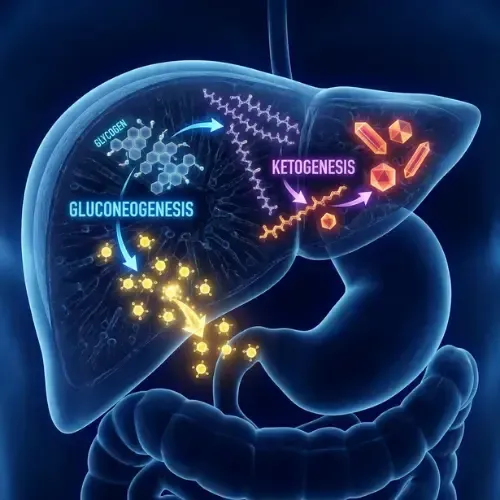
Glucagon Benefits for Fat Loss
Every conversation about blood sugar and fat loss focuses on insulin. But insulin has a counterpart that does the opposite job — and understanding it may be more important.

Visceral Fat vs. Subcutaneous Fat
Not all body fat is equal — and the difference matters more than almost anything else in metabolic health. One type stores energy quietly.

What Is HOMA-IR
Most people with insulin resistance have normal blood sugar. That's exactly why the standard blood sugar test misses it. HOMA-IR — a calculation using fasting insulin and fasting glucose

John Shaw
MAP30 Challenge
John Shaw is a Certified Nutrition Educator and the founder of the MAP30 Challenge. What began as a personal health journey at 294 pounds, and pre-diabetic, evolved into a structured 30-day metabolic reset program grounded in nutritional science. John's mission is simple: give people the biological education that the diet industry never did.

FAQ's
1. What is metabolic flexibility?
Metabolic flexibility is the body's ability to efficiently switch between burning glucose and burning fat depending on fuel availability. A metabolically flexible person burns carbohydrates after a meal when insulin is elevated, and transitions smoothly to burning fat between meals and during fasting when insulin falls. A metabolically inflexible person is stuck burning primarily glucose and cannot efficiently access fat stores — producing energy crashes, persistent hunger, and difficulty losing body fat
2. What causes metabolic inflexibility?
Chronic metabolic inflexibility develops through persistently elevated insulin from frequent eating and high refined carbohydrate intake; continuous glucose availability that removes the adaptive need for fat burning; mitochondrial dysfunction in skeletal muscle from sedentary behavior and visceral fat accumulation; and chronic sleep restriction that elevates cortisol and fasting insulin while shortening the overnight fat-burning window. These conditions are common, compounding, and reversible.
3. How do you know if you are metabolically inflexible?
Practical signs: needing to eat within an hour or two of waking; energy crashes mid-morning or mid-afternoon; urgent, disruptive hunger between meals; strong cravings for sugar or refined carbohydrates; inability to skip a meal without feeling terrible; and persistent difficulty losing body fat despite dietary restriction. Blood markers — elevated fasting insulin, HOMA-IR above 2.0, and elevated fasting triglycerides — provide objective confirmation.
4. How long does it take to improve metabolic flexibility?
Most people notice meaningful changes within two to four weeks of consistent intervention — extended overnight fasting, reduced refined carbohydrates, prioritized protein, and improved sleep. Hunger urgency typically diminishes first. Energy stability follows. By six to eight weeks, the fat oxidation pathways have significantly upregulated and the subjective experience of metabolic flexibility — stable energy, optional meals, no afternoon crash — becomes consistent. Full restoration in significantly insulin-resistant individuals may take three to six months.
5. Is metabolic flexibility the same as ketosis?
No — though they are related. Ketosis is a specific metabolic state in which the liver produces ketones from fat at a rate that raises blood ketone levels measurably. Metabolic flexibility is a broader capacity — it includes the ability to enter ketosis when appropriate, but also efficient glucose burning after meals and seamless transitions between both states. A metabolically flexible person can enter and exit ketosis as fuel availability changes. A person who is only adapted to deep ketosis and struggles with glucose is also inflexible — just in the other direction.
6. What is the fastest way to improve metabolic flexibility?
The fastest single change is extending the overnight fast to 14 to 16 hours — achieved by stopping eating after dinner and delaying breakfast. This creates the sustained low-insulin period that directly activates fat oxidation pathways. Combining this with reduced refined carbohydrate intake accelerates the process significantly. Adding fasted morning walks — low-intensity exercise before breakfast — trains the enzymatic fat-burning machinery directly. Most people experience noticeable changes within two weeks of this combination.
Sources
Kelley DE, Mandarino LJ — 'Fuel selection in human skeletal muscle in insulin resistance' (Diabetes, 2000) — https://pubmed.ncbi.nlm.nih.gov/10909987/
Goodpaster BH, Sparks LM — 'Metabolic Flexibility in Health and Disease' (Cell Metabolism, 2017) — https://pubmed.ncbi.nlm.nih.gov/28467930/
Storlien L et al. — 'Metabolic flexibility and insulin resistance' (Proceedings of the Nutrition Society, 2004) — https://pubmed.ncbi.nlm.nih.gov/15294043/
Corpeleijn E et al. — 'Metabolic flexibility in the development of insulin resistance' (Obesity Reviews, 2009) — https://pubmed.ncbi.nlm.nih.gov/18673380/
Anton SD et al. — 'Flipping the Metabolic Switch' (Obesity, 2018) — https://pubmed.ncbi.nlm.nih.gov/29086496/

Let Me See The Ai Audit Report
I had the MAP30 course material audited and graded by 4 dirrerent Ai models. I was shocked by the grade. See what they had to say about the MAP30 course.

Jaabsha Marketing LLC | All rights reserved 2024 Terms Of Service